Rafael Walter · 24 September 2026
Atmospheric Salt Spray Deposition Shapes Plant Community Structure on Coastal Dunes Through Consistent Patterns of Aerosol Transport and Localized Accumulation
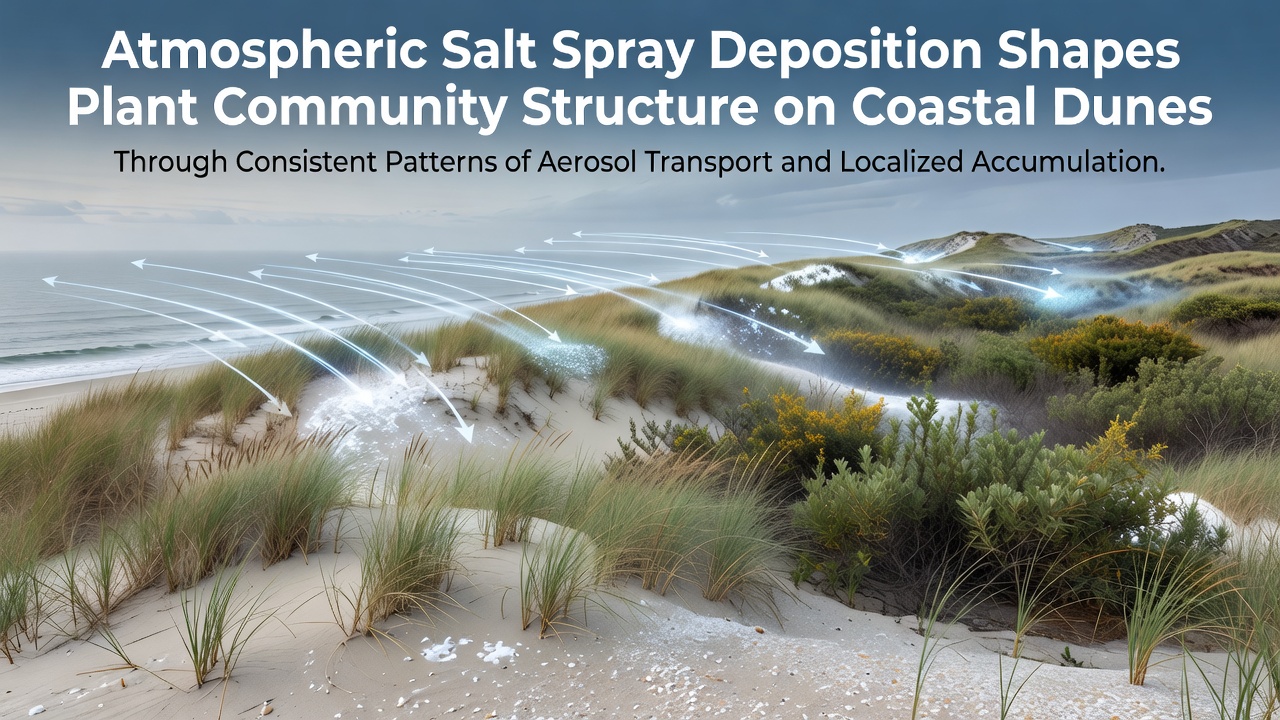
Atmospheric salt spray moves across coastal dunes in predictable ways that researchers have tracked through field measurements and aerosol modeling, and these movements create distinct zones where salt accumulates on plant surfaces and in surface soils. Wind patterns carry fine salt particles from breaking waves inland, while topography and vegetation height influence where those particles settle, leading to measurable gradients in salinity exposure that shape which species survive and thrive at different distances from the shoreline.
Aerosol Transport Mechanisms in Coastal Environments
Prevailing onshore winds pick up salt aerosols at the surf zone and carry them varying distances depending on wind speed, particle size, and atmospheric stability, and studies using deposition collectors show that most salt falls within the first 100 to 300 meters of the beach edge during typical conditions. Larger droplets settle quickly near the foredune, whereas finer aerosols travel farther before gravity and vegetation interception pull them down, creating a tapering deposition curve that multiple monitoring networks have documented across different coastlines. Seasonal shifts in wind direction and storm frequency alter these patterns, with stronger winter storms producing spikes in inland transport that researchers record through increased sodium levels in leaf tissues and soil samples.
Localized Accumulation and Soil-Plant Interactions
Once salt aerosols reach the dune surface, they accumulate unevenly because of microtopography, leaf area index, and moisture levels, and depressions or dense plant patches trap more particles while exposed crests shed some through runoff during rain events. Soil salinity measurements taken at regular intervals reveal higher concentrations on the windward slopes of secondary dunes compared with leeward sides, and this spatial variation correlates directly with changes in plant cover and species composition. Salt that settles on foliage draws moisture from leaf tissues during dry periods, increasing desiccation stress that favors drought-tolerant species while limiting recruitment of less adapted plants.
Plant Community Responses to Salt Gradients
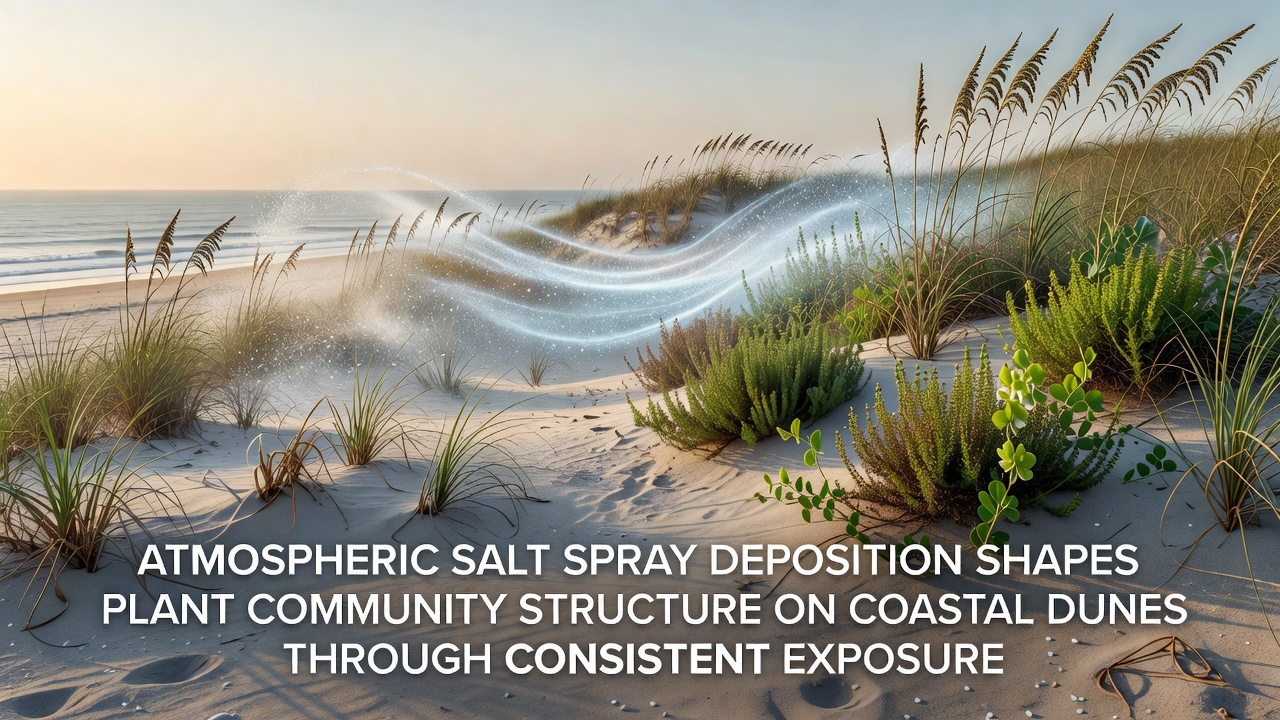
Plant communities on coastal dunes sort themselves along these salt deposition gradients, with pioneer species near the beach tolerating high exposure through specialized leaf structures and rapid growth cycles, while inland communities shift toward shrubs and grasses that require lower salinity levels to establish. Data from long-term vegetation plots show that species richness often peaks at intermediate distances where salt stress decreases enough to allow more competitors yet remains high enough to exclude inland weeds. Root systems respond as well, with many foredune plants developing shallower but denser roots that avoid deeper saline layers, and observers note that this architecture stabilizes sand while influencing how much additional salt reaches the surface through reduced wind speeds.
Monitoring Data and Geographic Patterns
Networks operated by agencies such as the National Oceanic and Atmospheric Administration have compiled deposition records that demonstrate consistent relationships between wind fetch, aerosol load, and vegetation boundaries across U.S. Atlantic and Pacific sites, and parallel programs in Australia reveal similar transport distances despite differences in tidal range and dune morphology. European monitoring coordinated through the European Environment Agency has tracked comparable patterns along North Sea coasts, where localized accumulation near infrastructure corridors sometimes intensifies stress on remaining native stands. Figures collected through September 2026 continue to confirm that deposition rates scale with storm frequency rather than average wind speed alone, providing clearer input for predictive models that forecast community shifts under changing climate conditions.
Interactions with Other Environmental Factors
Salt spray effects interact with sand burial, nutrient availability, and herbivory, and researchers have found that plants already stressed by burial show greater sensitivity to additional salt loads because energy reserves are diverted to vertical growth. Nutrient leaching from salt-affected soils further limits nitrogen uptake in some zones, reinforcing the dominance of nitrogen-fixing species that can tolerate both conditions. Burrowing animals and occasional overwash events reset local accumulation patterns by mixing surface layers, yet these disturbances tend to reinforce rather than erase the broader gradients established by aerosol transport over longer timescales.
Conclusion
Atmospheric salt spray deposition creates repeatable patterns of aerosol transport and localized accumulation that directly influence the structure and composition of plant communities on coastal dunes. Field measurements, deposition modeling, and vegetation surveys together demonstrate how wind-driven salt movement sorts species along predictable gradients while interacting with other dune processes. Continued monitoring through established networks supplies the data needed to track these dynamics and inform management approaches that account for both natural variability and long-term environmental change.