Yara Krause · 10 September 2026
Wind-Driven Sediment Flows and Their Influence on Coastal Infrastructure Longevity
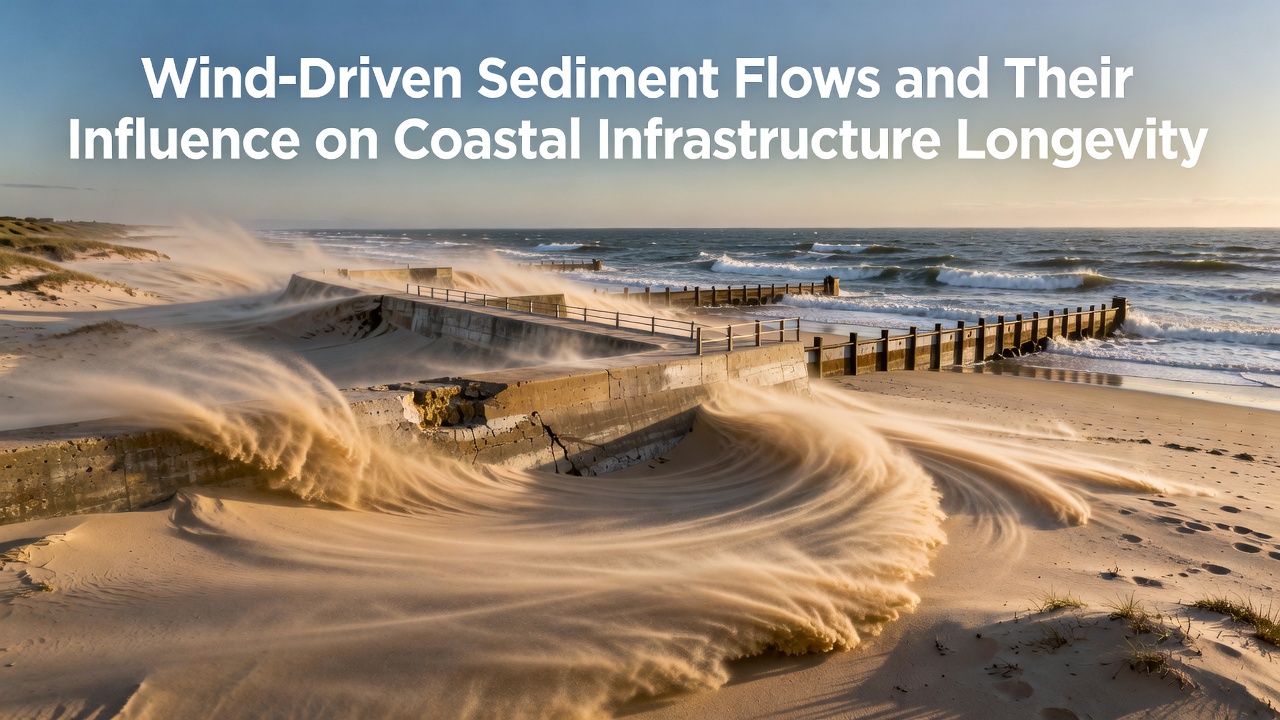
Wind-driven sediment flows shape coastlines through consistent aeolian transport that moves sand particles across beaches and dunes, and this movement directly affects the structural integrity of roads, seawalls, piers, and buildings over decades. Researchers document how prevailing winds pick up dry sand from exposed intertidal zones and carry it inland or alongshore, creating patterns of erosion in one area and accretion in another, while data from long-term monitoring stations show these processes accelerate when vegetation cover decreases or storm frequency increases.
Mechanisms of Aeolian Sediment Transport
Wind initiates sediment movement once its speed exceeds the threshold for particle entrainment, and saltation becomes the dominant mode where grains bounce along the surface and dislodge others, whereas suspension carries finer particles higher into the air column. Studies from multiple coastal research programs indicate that fetch length, surface moisture content, and grain size distribution control transport rates, with dry, well-sorted sands moving most readily during sustained onshore or alongshore winds. Observers note that seasonal wind patterns often produce net directional transport that shifts sediment budgets between adjacent beach compartments, and this redistribution alters the protective buffer that dunes provide to landward infrastructure.
Measurements collected at instrumented sites reveal that wind speeds above 6 meters per second frequently initiate measurable transport on temperate coasts, while stronger events during autumn and winter months generate the bulk of annual sediment flux. Those who've analyzed high-resolution lidar surveys find that small changes in dune crest elevation or vegetation density can redirect flow paths, concentrating erosion at the base of engineered structures or smothering access roads with fresh deposits. The reality is that these flows operate continuously rather than only during extreme storms, so cumulative effects compound over years and shorten the functional lifespan of concrete footings, timber pilings, and buried utilities.
Effects on Coastal Structures and Longevity
Coastal infrastructure experiences accelerated wear when sediment flows remove supporting material from foundations or deposit abrasive loads against surfaces, and engineers record higher maintenance frequencies at locations where dunes have narrowed due to persistent transport. Data from monitoring programs show that piers and revetments lose stability when adjacent beach profiles lower by even modest amounts, because reduced elevation allows larger waves to reach the structure during subsequent high-water events. Researchers have tracked cases where wind-blown sand infiltrates mechanical joints and drainage systems, leading to premature corrosion or clogging that requires intervention years earlier than design estimates predicted.
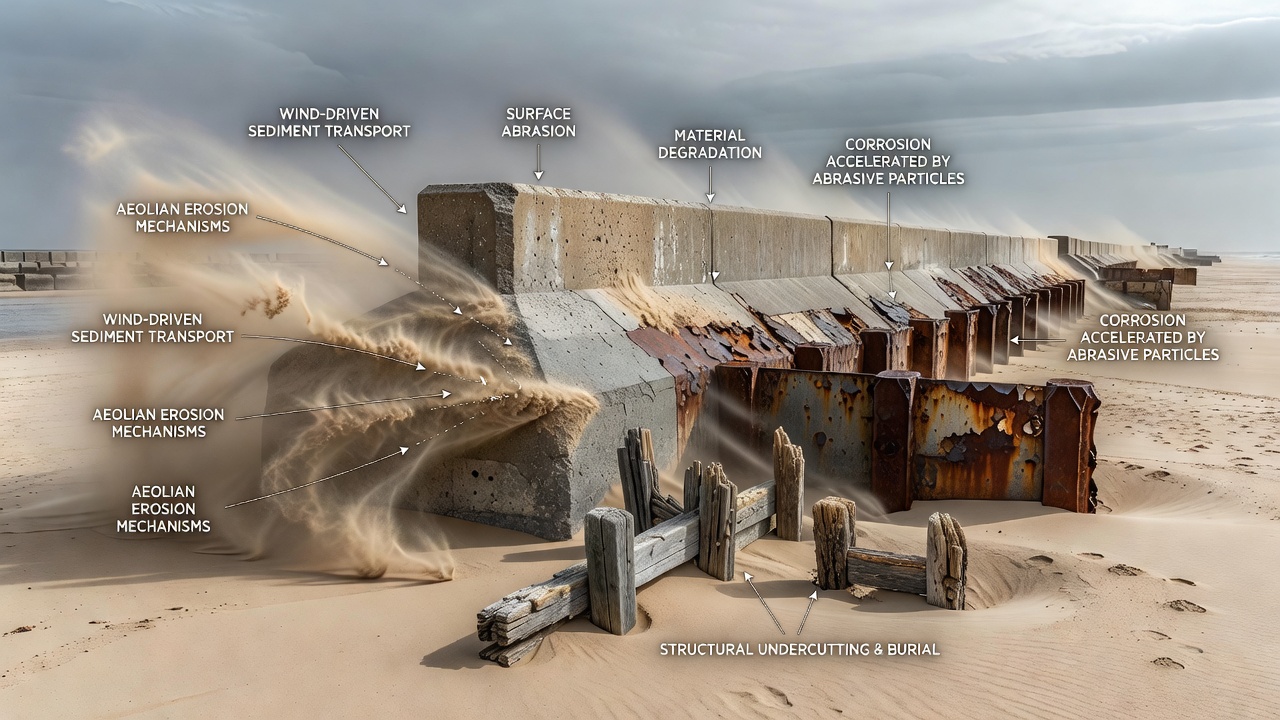
Long-term records compiled by government agencies demonstrate that accretion zones can also create problems when sand buries access points or alters drainage gradients around buildings and parking areas. One study revealed that repeated burial events increased the frequency of clearing operations for certain boardwalks and parking facilities, raising operational costs while shortening intervals between major refurbishments. Experts observe that structures built on dynamic shorelines face variable sediment regimes that shift with changes in wind climate or offshore sediment supply, making predictive maintenance schedules more difficult to maintain without ongoing field measurements.
Regional Observations and Monitoring Approaches
Along the Atlantic and Gulf coasts of the United States, USGS coastal change research tracks how wind-driven transport interacts with engineered shorelines, while comparable programs in Australia through CSIRO document similar interactions on exposed sandy coasts. European monitoring networks gather parallel datasets that highlight regional differences in transport rates tied to prevailing wind directions and sediment availability. These efforts produce maps of sediment pathways that planners use when siting new infrastructure or planning reinforcement of existing assets.
Figures reveal that locations with frequent wind reversals experience more complex patterns of erosion and deposition than unidirectional regimes, and this complexity influences decisions about setback distances and foundation depths. People responsible for asset management often integrate wind data with sediment budgets to forecast when protective dunes may require nourishment or when structures may need elevation adjustments. The ball's in the court of local authorities to decide how frequently to update these assessments as wind patterns evolve.
Adaptation Measures and Infrastructure Planning
Communities implement sand fencing, vegetation planting, and periodic nourishment to modulate wind-driven flows and extend the service life of coastal assets, and records indicate these interventions can reduce foundation exposure rates when applied consistently. Planners incorporate sediment transport models into design standards so that new roads and utilities account for expected accretion or deflation over the projected lifespan of the facility. Data shows that combining hard structures with nature-based features often yields longer intervals between major repairs than either approach alone.
Monitoring continues to refine these strategies as wind and wave climates shift, and agencies in multiple countries share best practices for balancing sediment movement with infrastructure protection. What's interesting is how small adjustments in dune management timing can produce measurable differences in long-term maintenance demands.
Conclusion
Wind-driven sediment flows represent a persistent driver of change along sandy coastlines, and their influence on infrastructure longevity appears through both erosional undercutting and depositional overloading. Continued data collection from diverse geographic regions supports more accurate forecasting of maintenance needs and informs placement decisions that align with natural transport pathways. Those managing coastal assets benefit from integrating ongoing observations into planning cycles so that structures retain functionality across changing sediment regimes.